
Tankless Water Heater Repair vs. Replacement: When Does Replacement Make More Sense?
When a tankless water heater develops a problem, replacement is not automatically the answer.
One advantage of a quality tankless system is that many individual components can be diagnosed and replaced. Depending on the failure, repairing the existing unit may be considerably less expensive than installing a new water heater.
But there is also a point where continuing to repair an aging tankless unit may no longer make financial sense.
When we evaluate a tankless water heater, several factors influence that decision.
The most important one is usually age.
Start With the Age of the Tankless Water Heater
A relatively young tankless water heater with a repairable component failure is usually much easier to justify repairing than an older unit approaching the end of its expected useful life.
Even if an older unit can technically be repaired, the question becomes:
How much money should be invested in this water heater before another aging component fails?
If the tankless unit has otherwise been reliable and still has substantial useful life remaining, repairing it may be the obvious choice.
If the unit is considerably older and beginning to develop multiple problems, replacement deserves serious consideration.
We do not look only at whether the current part can be replaced.
We look at the condition and age of the entire appliance.
Warranty Coverage Can Completely Change the Decision
Warranty status is another major factor.
Some tankless components can be expensive.
If a failed component is covered under the manufacturer’s warranty, the economics of repairing the existing water heater can look very different than if the homeowner has to pay the full cost of the part.
A major repair that might be difficult to justify on an older, out-of-warranty heater can make considerably more sense when the manufacturer is supplying an expensive component under warranty.
Before recommending replacement, we consider whether the failed component may still have warranty coverage and what costs would remain for the homeowner.
The Cost of the Parts Matters
Not every tankless repair is a major repair.
A sensor, igniter, flow-related component or other relatively inexpensive part may be a straightforward repair, particularly when the water heater is otherwise in good condition.
Other failures can involve much more expensive components.
One example is a heat exchanger.
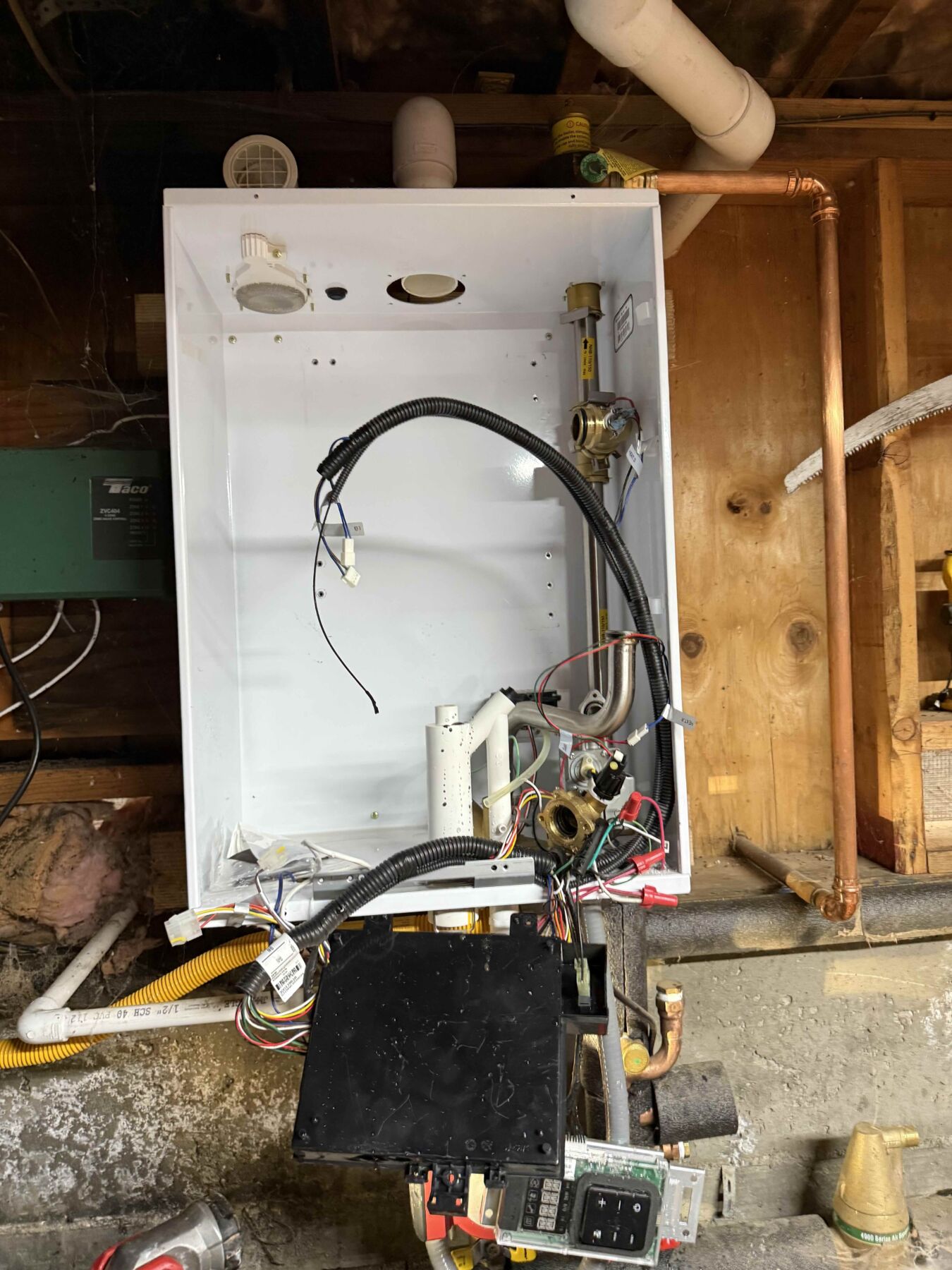
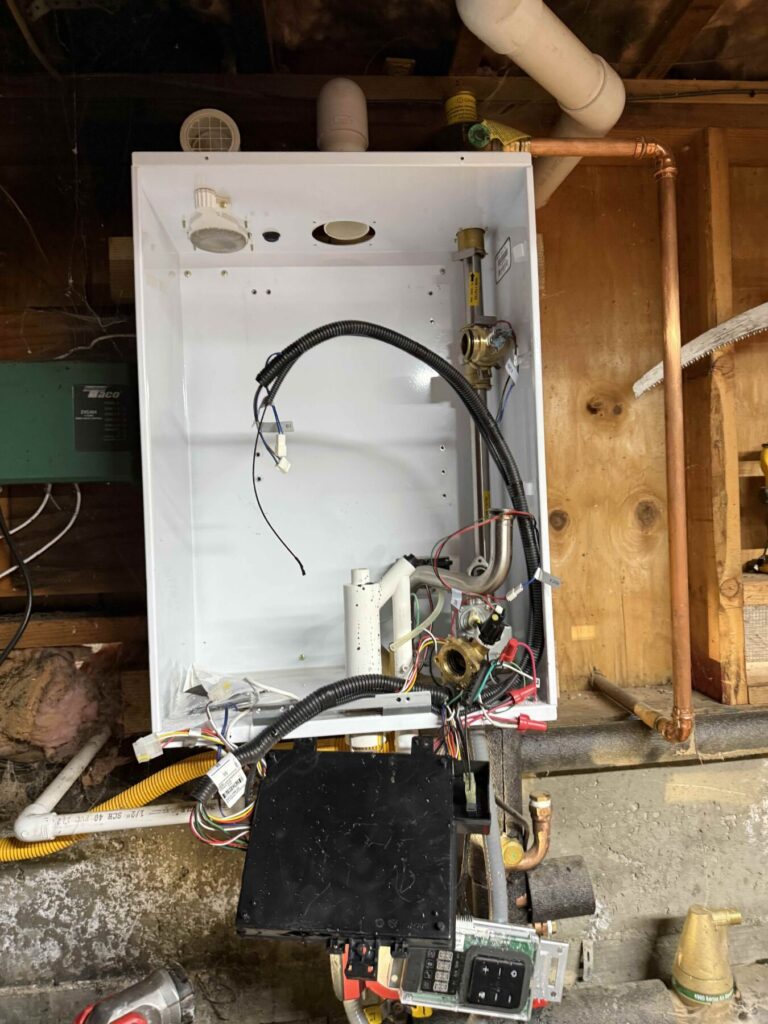
The photo shown with this article illustrates how extensively a Navien appliance may need to be disassembled during a major heat-exchanger repair. The particular appliance photographed may have been a boiler-type Navien unit, but the image demonstrates the amount of teardown and component access that can be involved in major Navien service work.
When the failed part is expensive and substantial labor is required to replace it, we begin comparing the total repair investment with the cost and expected life of a new unit.
A Major Repair Can Involve Significant Labor
The price of the replacement part is only one part of the repair.
Some tankless components are readily accessible.
Others can require much of the appliance to be disassembled.
A major repair may involve:
- Removing the cabinet and internal components
- Draining portions of the system
- Disconnecting water or gas components
- Removing wiring harnesses and sensors
- Replacing the failed assembly
- Reassembling the appliance
- Refilling and purging the system
- Testing for leaks
- Verifying combustion and operation
- Confirming that the original problem has actually been corrected
That labor has to be considered along with the price of the part.
On a newer heater, substantial repair work may still make good economic sense.
On an older heater, the same repair can become harder to justify.
Parts Availability Can Be Just as Important as Parts Cost
Even when repairing the heater makes financial sense, the necessary part has to be available.
Parts availability can vary by model and age.
A common component for a current model may be readily available.
A less common component for an older or discontinued unit may take considerably longer to obtain.
That creates another question homeowners have to consider:
How long are you willing to be without reliable hot water while waiting for a repair?
If the required part can arrive quickly, repairing the existing unit may be practical.
If an important part is backordered or difficult to locate and the homeowner needs hot water immediately, replacement can become the more practical option even if the unit could theoretically be repaired.
Diagnostic Time and Multiple Trips Matter
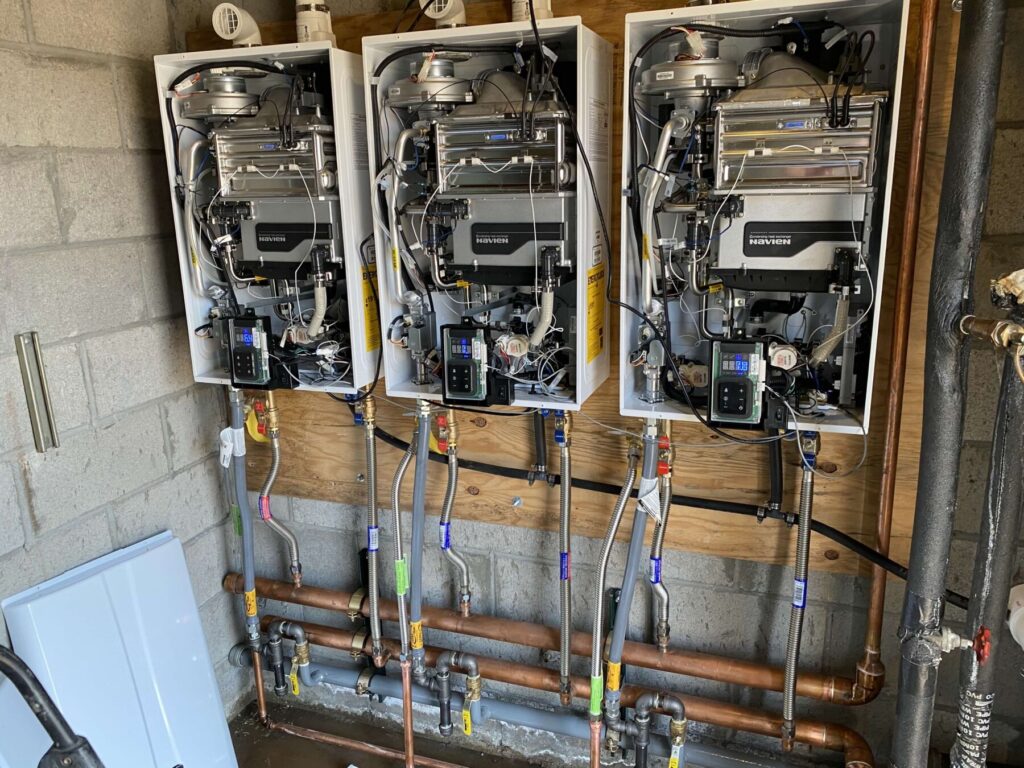
Tankless water heaters contain combustion components, water-flow components, sensors, electronics and controls that all work together.
Some failures are obvious.
Others require diagnosis.
Occasionally a service problem involves more than one component or an initial symptom leads to additional testing.
The homeowner should consider not only the cost of one part, but potentially:
- Diagnostic labor
- Return trips
- Additional testing
- Parts ordering
- Installation labor
- The possibility that another problem is discovered after the first repair
This is particularly important on an older appliance.
At some point, repeatedly spending money to diagnose and repair an aging unit can become less attractive than installing a new system with new components and a new warranty.
One Error Code Does Not Automatically Mean Replacement
An error code is a starting point for diagnosis, not necessarily a reason to replace the water heater.
Depending on the problem, the cause could be relatively simple.
Potential issues can involve:
- Ignition
- Flame detection
- Water flow
- Temperature sensors
- Venting
- Air supply
- Gas supply
- Scale or restriction
- Condensate drainage
- Pumps or recirculation components
- Electronic controls
The actual cause should be diagnosed before making a repair-versus-replacement decision.
Replacing an entire tankless water heater because of a repairable component failure can be unnecessarily expensive.
Maintenance History Matters Too
The history of the appliance can provide useful information.
A tankless water heater that has been maintained, flushed when appropriate and has otherwise operated reliably may be a better repair candidate than an older unit with years of deferred maintenance and recurring problems.
We look at whether the current failure appears to be an isolated issue or part of a developing pattern.
One repair on an otherwise healthy unit is different from the third or fourth significant repair on an aging system.
When We Generally Lean Toward Repair
Repair often makes sense when:
- The tankless water heater is relatively young
- The overall unit is in good condition
- The failed component is reasonably priced
- The component is covered by warranty
- Parts are readily available
- The failure appears isolated
- The homeowner can tolerate the repair timeline
- The expected repair cost is reasonable compared with replacement
In these situations, replacing the entire water heater may provide little benefit.
When We Begin Considering Replacement
Replacement becomes more attractive when:
- The tankless unit is approaching the later part of its useful life
- A major component has failed
- The unit is outside warranty
- Parts are expensive
- Parts are difficult to obtain
- The repair requires extensive labor
- Multiple service calls have already been required
- Other components are showing signs of age
- The homeowner cannot reasonably wait for repair parts
- The total repair investment begins approaching a meaningful portion of replacement cost
There is no single dollar amount or age at which every tankless unit should automatically be replaced.
The decision should be based on the specific appliance and circumstances.
Repairing an Older Unit Can Sometimes Be False Economy
A lower repair bill does not always mean the repair is the least expensive decision long term.
For example, spending significant money replacing a major component on an older tankless heater may restore operation today.
But that repair does not make the rest of the appliance new.
The fan, controls, sensors, gas components and other parts are still the same age.
That does not mean they will fail soon, but their age should be part of the decision.
Sometimes investing more in a new heater with new components and warranty coverage is the better long-term value.
On the Other Hand, Don’t Replace a Good Heater Unnecessarily
The opposite is also true.
A relatively young tankless water heater should not necessarily be discarded because one replaceable component failed.
Quality tankless equipment is designed to be serviced.
If the unit has substantial expected life remaining and the repair is reasonable, repairing the heater may be far more economical than replacing it.
The goal is not to sell the largest job.
It is to determine which option makes the most sense for the homeowner.
Tankless Water Heater Diagnosis, Repair & Replacement
Optimized Plumbing & Piping services, repairs and installs tankless water heaters.
When a tankless system develops a problem, we evaluate the age and overall condition of the appliance, the failed component, warranty status, parts availability, diagnostic requirements and total repair cost.
Sometimes the answer is a straightforward repair.
Sometimes an expensive repair on an older unit does not make sense.
And sometimes the biggest factor is simply how long a homeowner can reasonably wait for a part while living without reliable hot water.
Looking at all of those factors together helps determine whether repairing the existing tankless water heater or replacing it is the better investment.
Optimized Plumbing & Piping
Tankless water heater diagnosis, repair, replacement and service.