Tankless Water Heater Maintenance & Flushing: What Homeowners Should Know
One advantage of a tankless water heater is that the system is designed to be serviced rather than simply ignored until something fails.
That does not mean a tankless water heater is maintenance-free.
Water continuously passes through a compact heat exchanger where a large amount of heat is transferred in a small space. Minerals in the water can gradually accumulate inside those waterways, particularly in homes with harder water.
For that reason, periodic maintenance and heat-exchanger flushing are an important part of owning a tankless water heater.
Why Does a Tankless Water Heater Need to Be Flushed?
When water is heated, dissolved minerals such as calcium and magnesium can form deposits inside the heat exchanger.
Over time, that mineral buildup — commonly called scale — can interfere with heat transfer and restrict water flow.
The amount of buildup depends heavily on the home’s water quality, operating conditions and usage.
A home with relatively soft water may accumulate scale much more slowly than a home supplied with very hard well water.
The purpose of flushing is to circulate an appropriate cleaning solution through the heat exchanger to help remove those mineral deposits before they become a larger problem.
How Often Should a Tankless Water Heater Be Serviced?
The manufacturer’s instructions for the specific water heater should always be followed.
Navien currently recommends annual maintenance for its tankless water heaters and notes that homes with hard water may require more frequent attention.
That does not mean every home will accumulate scale at exactly the same rate.
Water hardness, household usage, temperature settings and other installation conditions can all affect how quickly mineral deposits develop.
This is why water quality is an important part of the maintenance discussion.
What Happens During a Tankless Flush?
A typical heat-exchanger flush involves isolating the tankless water heater from the home’s domestic water system and circulating cleaning solution through the heat exchanger.
The basic setup includes:
- Hot and cold isolation valves
- Service ports
- Hoses
- A circulation pump
- A bucket or reservoir
- An appropriate flushing or descaling solution
The pump circulates the solution through the water heater for the required period, after which the system is thoroughly rinsed and returned to normal operation.
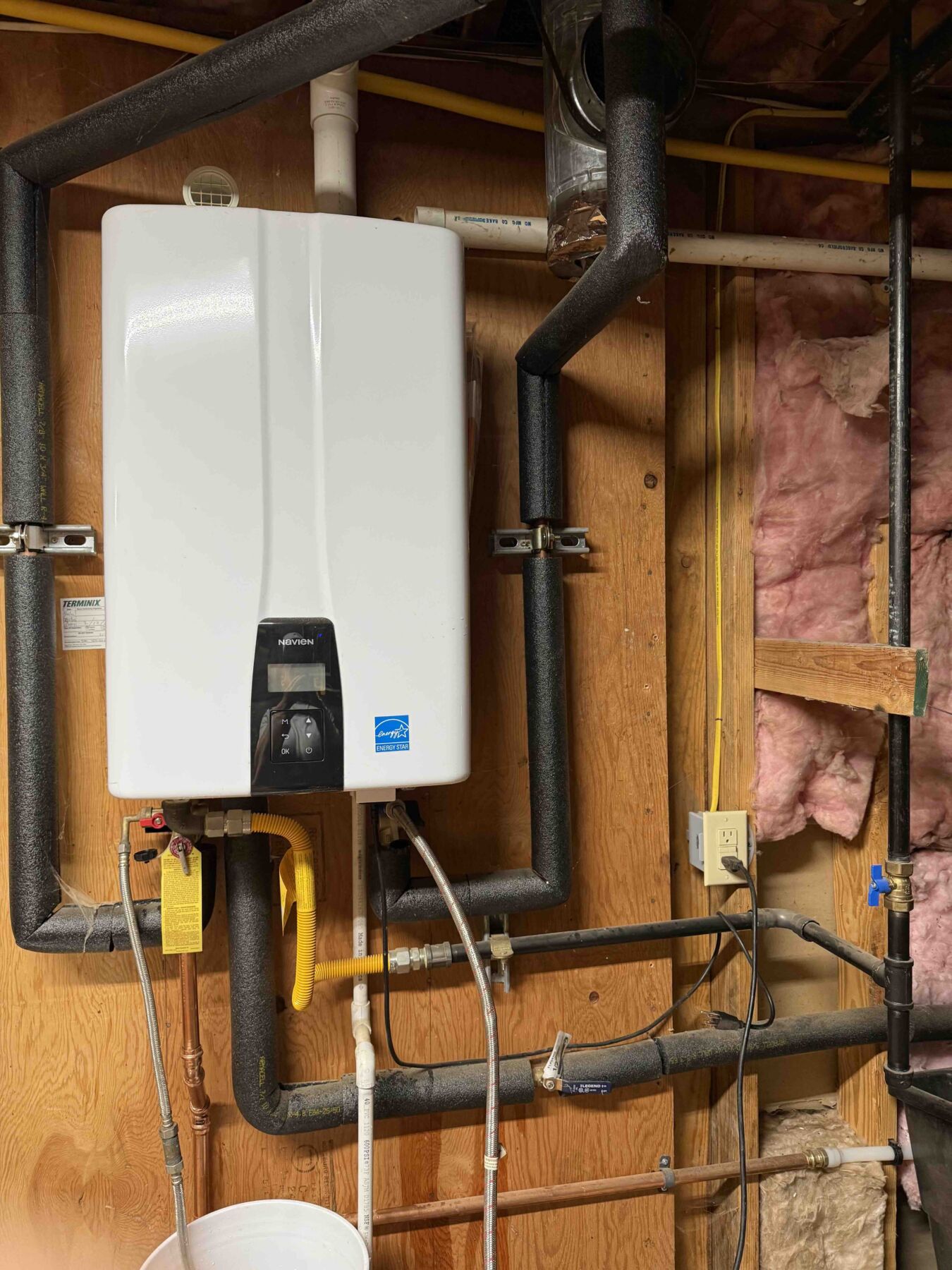
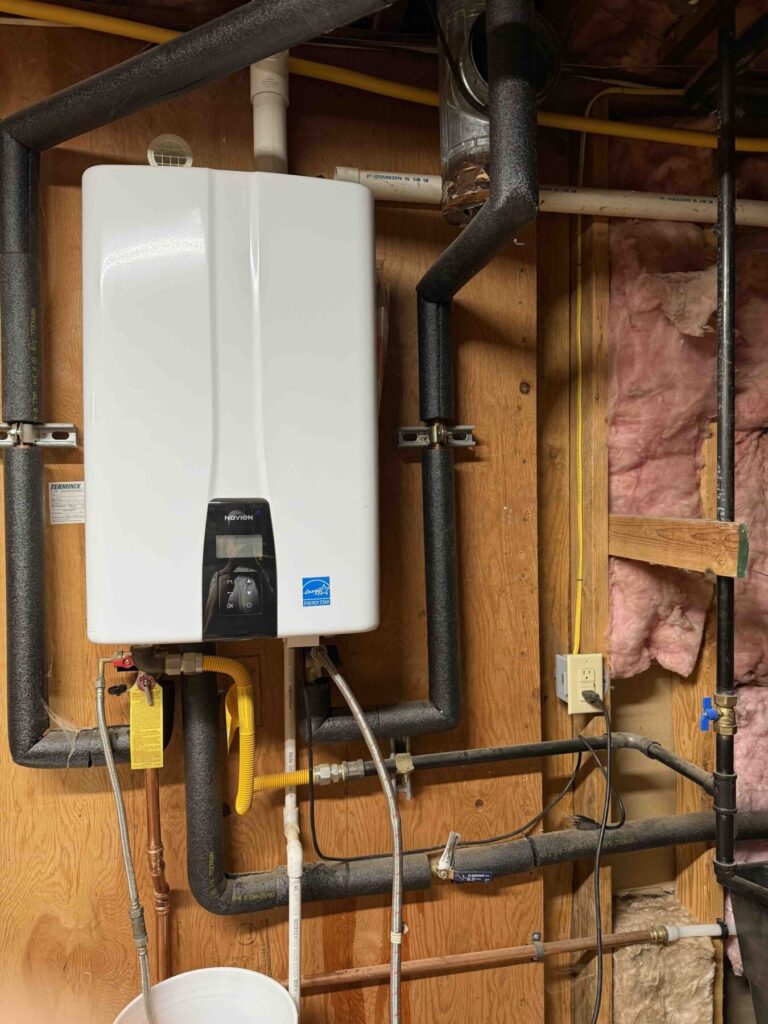
The photo shown with this article is an actual Navien tankless water heater connected for flushing through its service valves.
Why We Install Brass Service Valves
Our tankless water-heater installations include a brass isolation and service-valve set.
These valves serve an important purpose.
They allow the water heater to be isolated from the rest of the home’s plumbing and provide connections where flushing hoses can be attached.
Without properly installed service valves, routine heat-exchanger maintenance becomes substantially more difficult.
Installing them when the tankless water heater is first installed makes future service much easier.
It also gives the homeowner options.
Can a Homeowner Flush Their Own Tankless Water Heater?
Some homeowners choose to perform their own routine heat-exchanger flush.
With properly installed service valves, a circulation pump, hoses and the correct cleaning solution, the basic flushing process can be relatively straightforward for someone who is comfortable following the manufacturer’s instructions.
However, homeowners should understand that the water heater involves more than just the domestic-water circuit.
A tankless unit also contains gas, electrical, combustion, venting and condensate components.
The manufacturer’s instructions should be followed carefully, and homeowners who are not comfortable servicing the equipment should have the work performed professionally.
Optimized Plumbing & Piping also provides tankless water-heater flushing and maintenance for customers who prefer not to perform the service themselves.
Maintenance Is More Than Running Cleaning Solution Through the Heater
Flushing the heat exchanger is an important part of tankless maintenance, but it should not necessarily be the only thing considered.
Depending on the model, manufacturer maintenance can also include items such as:
- Cleaning the cold-water inlet screen
- Inspecting or cleaning the air-intake filter
- Checking the condensate trap
- Looking for water or condensate leaks
- Inspecting venting and combustion-air components
- Checking the condition of service valves and piping
- Verifying proper operation after service
The goal is not simply to connect a pump and circulate solution.
It is to make sure the tankless system is continuing to operate properly as a complete appliance.
Water Quality Makes a Difference
Two identical tankless water heaters installed in different homes may have very different maintenance needs because of the water supplying them.
Hard-water minerals can accelerate scale formation.
If mineral buildup is occurring rapidly, it may make sense to look beyond repeated flushing and consider the home’s water quality itself.
Depending on the water conditions and the homeowner’s needs, water treatment may help reduce scale formation and protect more than just the water heater.
This can also benefit fixtures, faucets and other water-using equipment throughout the home.
What Happens If Scale Is Allowed to Build Up?
Scale acts as an unwanted layer between the heat source and the water flowing through the heat exchanger.
Heavy mineral accumulation can contribute to:
- Reduced heat-transfer performance
- Restricted water flow
- Reduced hot-water performance
- Increased stress on the equipment
- Service problems or error conditions
- Potentially shortened component life
Routine maintenance is intended to address buildup before it reaches that point.
How Is Tankless Maintenance Different From Tank-Water-Heater Maintenance?
Tank and tankless water heaters have different designs and therefore different maintenance procedures.
A conventional tank stores a large volume of water. Depending on the manufacturer and model, maintenance may involve checking the anode rod, flushing sediment from the bottom of the tank, inspecting safety components and servicing other parts of the installation.
A tankless water heater does not have a large storage tank or conventional sacrificial tank anode.
Instead, maintenance focuses more heavily on the heat exchanger, water screens, air intake, condensate system and other components specific to the appliance.
This is one reason homeowners should not assume that a tankless water heater can simply be installed and forgotten.
Maintenance Can Also Be an Opportunity to Catch Problems Early
A water heater does not always go directly from operating perfectly to complete failure.
Small issues can develop first.
During service, we may notice something such as:
- Evidence of leakage
- Restricted filters
- Abnormal operating behavior
- Venting concerns
- Condensate drainage problems
- Aging components
- Signs of excessive mineral buildup
Finding a developing issue during routine service can sometimes prevent a more inconvenient failure later.
Tankless Maintenance Is Different From Tankless Repair
Routine maintenance and repair are not the same thing.
Maintenance is preventive work intended to keep a properly operating water heater in good condition.
Repair becomes necessary when there is an actual problem such as:
- No hot water
- Temperature fluctuations
- Error codes
- Ignition problems
- Flow-related problems
- Leaking components
- Failed sensors, controls or other parts
Flushing a tankless water heater should not be treated as a cure for every error code or performance problem.
If a tankless unit is already malfunctioning, the cause should be diagnosed rather than assuming scale is responsible.
Serviceability Is One Reason We Like Tankless Systems
One characteristic we like about quality tankless equipment is that the system is designed with long-term service in mind.
Individual components can be accessed, the heat exchanger can be flushed, filters can be cleaned and the appliance can be diagnosed when a problem develops.
That does not guarantee that every repair is economical or that a tankless water heater will last indefinitely.
But a properly installed system with appropriate maintenance gives the homeowner a good opportunity to protect the investment over the long term.
Tankless Water Heater Flushing & Service
Optimized Plumbing & Piping installs, services and maintains tankless water heaters.
Our tankless installations include brass isolation and service valves so the water heater is set up for future heat-exchanger flushing.
Homeowners who are comfortable performing routine maintenance can use those service connections while following the manufacturer’s instructions.
For customers who would rather have the system serviced professionally, we also provide tankless flushing and maintenance.
The goal is simple: install the water heater correctly from the beginning and make it practical to maintain throughout its service life.
Optimized Plumbing & Piping
Tankless water heater installation, flushing, maintenance and service.