Combi Boiler for Radiant Heat and Domestic Hot Water: How One System Can Do Both
A hydronic heating system does not always need a separate boiler and water heater.
For the right home, a combi boiler can provide both the hot water used for radiant heating and the domestic hot water used at sinks, showers and other plumbing fixtures.
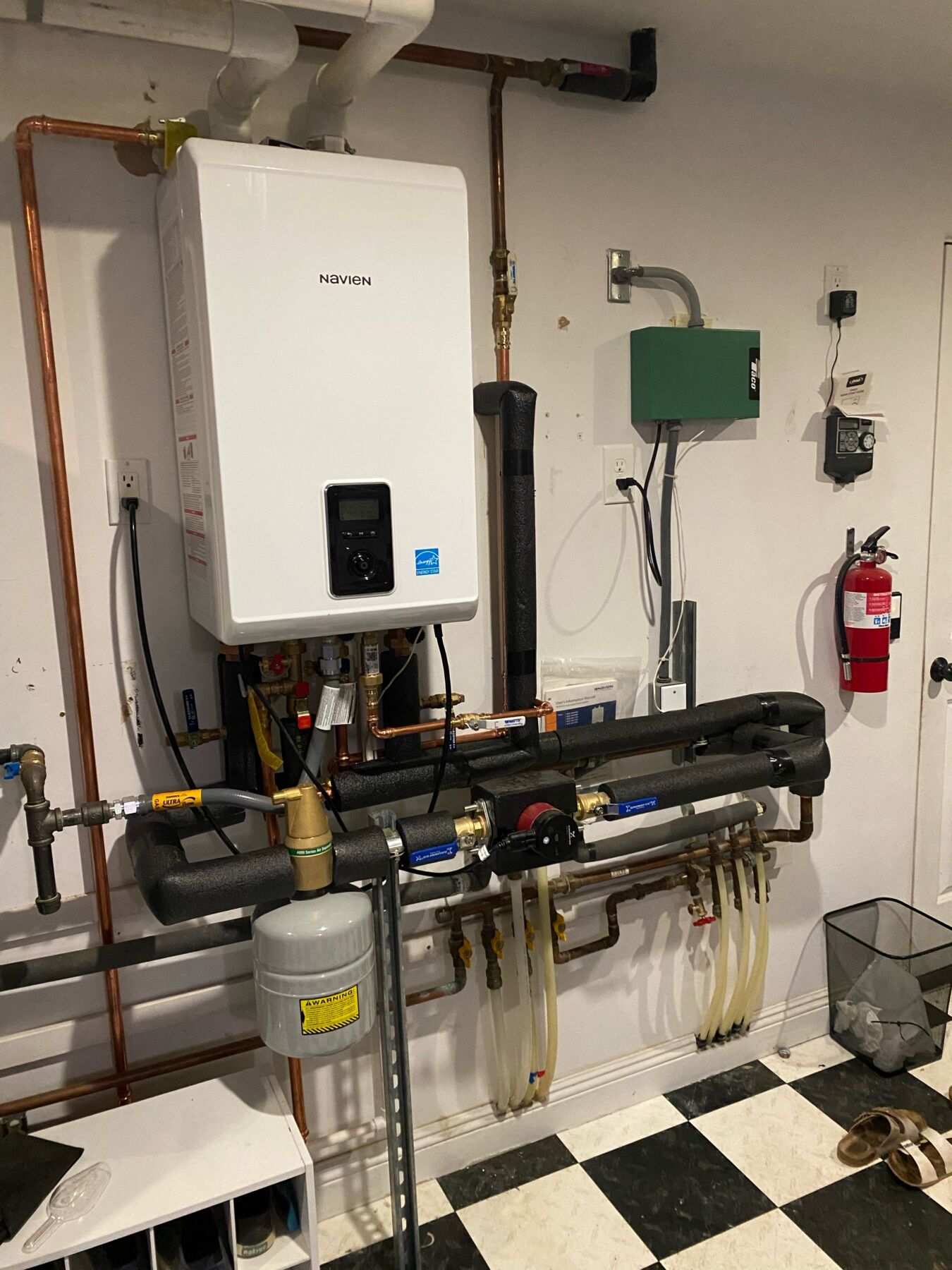
We installed this Navien NCB combi boiler in a foothill home between Jamestown and Copperopolis after the homeowners experienced a failure of their existing heating and domestic hot-water system.
Their previous setup used a Polaris water heater together with a solar thermal system. When the system failed, the homeowners were left without both radiant floor heat and reliable domestic hot water.
Rather than replacing the equipment with a separate boiler and water heater, we redesigned the system around a Navien combi boiler.
Why Use a Combi Boiler?
A traditional hydronic system may use one appliance for space heating and a completely separate water heater for domestic hot water.
A combi boiler combines those functions into a single appliance.
For this project, that made economic sense because installing one properly sized combi boiler was less expensive than installing both a new boiler and a separate water heater.
It also created a more integrated system while still allowing the radiant heating side of the system to operate independently from the home’s domestic plumbing.
Radiant Heat and Domestic Hot Water Are Still Separate Systems
Although one appliance produces the heat for both purposes, the radiant heating water and domestic hot water do not mix.
The hydronic side is a closed-loop heating system that circulates heated water through the home’s radiant floor zones.
The domestic side heats fresh potable water for showers, sinks and other fixtures.
Inside the combi boiler, the appliance manages both loads and directs its heating capacity where it is needed.
Domestic Hot Water Priority
One important feature of this Navien NCB system is domestic hot-water priority.
When someone opens a hot-water fixture, the boiler temporarily gives priority to producing domestic hot water.
Once that demand ends, the system returns its attention to the radiant heating system.
This makes it possible for a single appliance to serve both functions without trying to heat the house and supply a large domestic hot-water demand at exactly the same time.
For most homes, temporarily interrupting space heating for a shower or other short domestic demand has very little effect on indoor comfort.
Five Zones of Radiant Heating
This home has a five-zone radiant heating system.
Multiple zones allow different areas of the home to call for heat independently rather than operating the entire radiant system every time one room needs additional heat.
The system includes:
- Navien NCB combi boiler
- Five radiant heating zones
- Zone valve controls
- Dedicated boiler pump
- System circulator pump
- Air separator
- Expansion tank
- Hydronic supply and return piping
- Domestic hot-water production
The boiler pump and system pump each have a specific role in maintaining proper flow through the boiler and the radiant system.
The zone controls determine which areas of the home require heat, while the circulators move heated water through the active zones.
Why an Air Separator Matters
Air inside a hydronic system can create noise, reduce circulation and interfere with system performance.
An air separator continuously helps remove entrained air from the heating water as it circulates through the mechanical system.
Along with the expansion tank, pumps and controls, it is one of the components that helps the entire hydronic system operate properly rather than simply having a boiler connected to a group of pipes.
More Than Simply Replacing a Boiler
This project required more than swapping one appliance for another.
The existing system had been relatively new but was not performing properly. We redesigned the mechanical system around the new combi boiler and incorporated the pumps, controls and piping necessary for the five radiant zones.
This is an important distinction with boiler work.
A high-quality boiler cannot correct a poorly designed hydronic system by itself. Proper performance also depends on flow, pumping, zoning, air elimination, expansion control and how all of those components work together.
The Homeowner’s Experience
The homeowner later left Optimized Plumbing & Piping a five-star Yelp review describing the project.
They explained that after moving into the home they discovered that both the water-heating and boiler systems had failed, leaving them without radiant heat or domestic hot water.
They also noted that there were relatively few licensed boiler contractors in the area who were comfortable working on a system of this complexity.
After the redesign and Navien combi boiler installation, the homeowner wrote that the system had been “working flawlessly” and specifically praised our knowledge of boiler systems and radiant heat flooring.
That type of project is a good example of why hydronic heating requires more than general plumbing knowledge.
Combi Boiler vs. Separate Boiler and Water Heater
A combi boiler is not automatically the best choice for every house.
The decision depends on factors such as:
- Size of the home
- Number of radiant heating zones
- Heating load
- Domestic hot-water demand
- Available gas supply
- Existing equipment
- Mechanical-room space
- Desired system configuration
For some homes, a dedicated boiler and separate water heater may still make more sense.
For others, a properly designed combi boiler can provide an efficient and cost-effective way to handle both radiant heating and domestic hot water with a single appliance.
Boiler, Radiant Heat and Hydronic System Service
Optimized Plumbing & Piping works on boilers, radiant floor heating and hydronic piping systems, including systems with multiple zones, circulator pumps, controls and domestic hot-water integration.
If you have an existing radiant heating system that is not operating properly, or you’re considering replacing an older boiler, the entire system should be evaluated rather than looking only at the appliance.
Proper hydronic performance comes from the boiler, pumps, controls, piping and heat-distribution system working together as one system.
Optimized Plumbing & Piping
Boiler, radiant heat and hydronic system service and installation.