Repair or Replace an Electric Water Heater? When a Standard Tank Still Makes Sense
When an electric water heater starts having problems, the first question is often whether it should be repaired or replaced.
There is no single answer that fits every situation. The age of the water heater, condition of the tank, type of failure, household hot-water demand and the homeowner’s long-term plans all matter.
A standard electric tank water heater is still a practical and economical choice for many homes, but in some cases it is worth comparing a conventional replacement with a higher-efficiency hybrid heat pump water heater before making a decision.
How Long Does a Standard Electric Water Heater Last?
Many conventional tank-style water heaters last roughly 10 to 15 years, although actual service life varies.
Water quality, operating temperature, maintenance, installation conditions and the condition of the tank’s protective components can all affect how long a water heater lasts.
Most conventional water-heater tanks are made from steel and protected internally by a glass lining and a sacrificial anode rod. Those protective systems help slow corrosion, but they cannot prevent it forever.
Eventually, corrosion can begin affecting the steel tank itself.
Once the tank starts leaking, repair is generally no longer practical.
When Does Repair Make Sense?
Not every electric water-heater problem means the tank needs to be replaced.
Depending on the age and condition of the unit, repairs may make sense for problems involving:
- Heating elements
- Thermostats
- Electrical connections
- Temperature controls
- Certain valves or external components
If the tank itself is still in good condition and the water heater is not near the end of its expected service life, repairing a failed component can be the most economical option.
We look at the entire situation rather than automatically recommending replacement.
When Replacement Usually Makes More Sense
There comes a point where continuing to repair an older water heater no longer makes financial sense.
Replacement is often the better choice when:
- The tank itself is leaking
- There is significant corrosion
- The water heater is already near or beyond its typical service life
- Multiple components are beginning to fail
- The repair cost is high compared with the value of the existing unit
- The homeowner is already considering a more efficient water-heating system
A leaking steel tank cannot generally be repaired in a way that restores the water heater to reliable service.
At that point, the decision becomes less about whether to replace the water heater and more about what type of replacement makes the most sense.
A Like-for-Like Electric Replacement Is Often the Lowest Upfront Cost
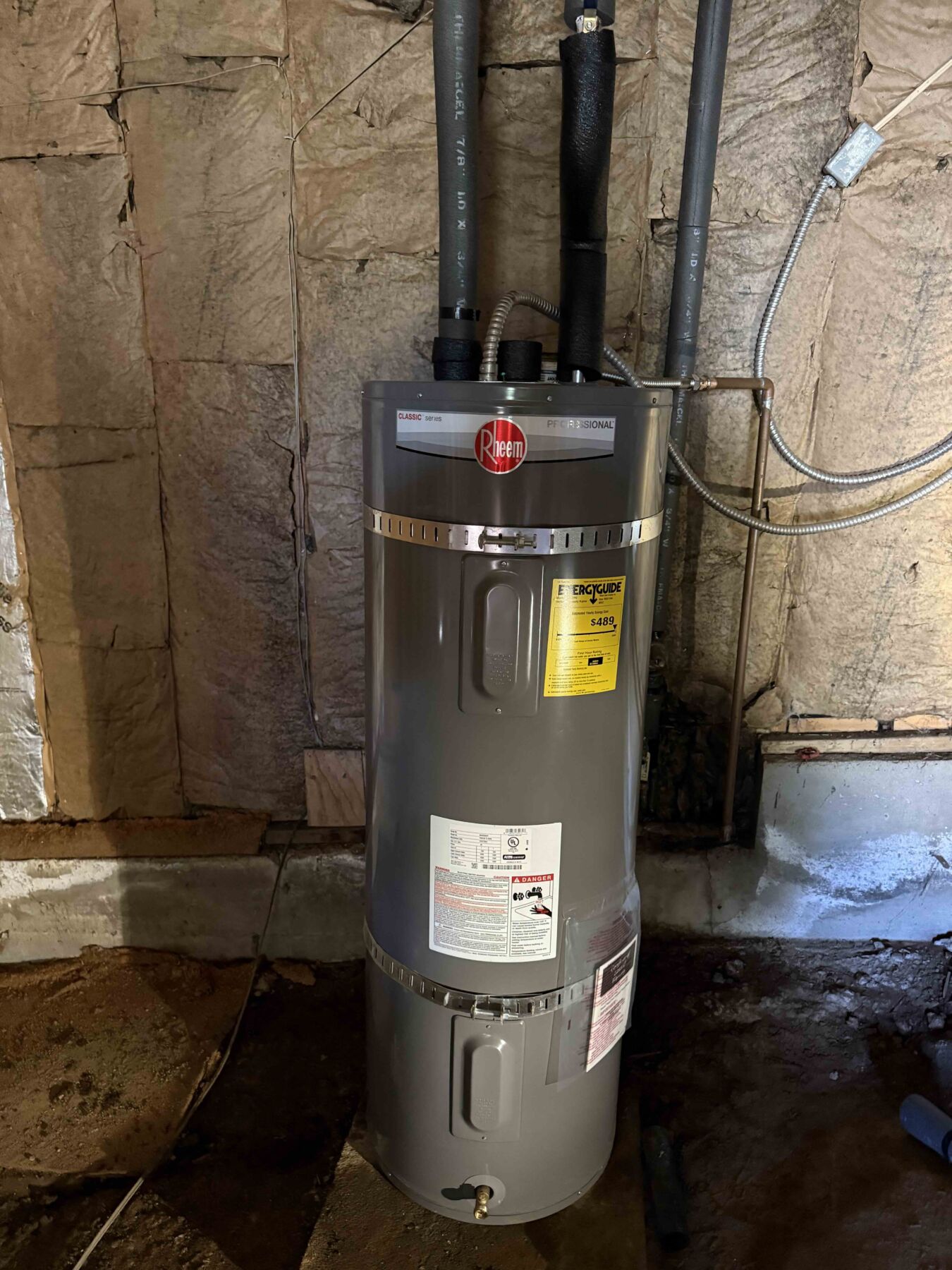
If the existing electric water heater has served the home well, replacing it with another standard electric tank is often the simplest and least expensive option upfront.
The electrical service is already in place, the plumbing connections are usually straightforward and the replacement can often fit into the same general space.
For homeowners focused primarily on initial cost and simplicity, a conventional electric tank may still be the right choice.
There is nothing wrong with choosing a standard replacement when it fits the home’s needs and budget.
Should You Consider a Hybrid Heat Pump Water Heater?
A water-heater failure can also be an opportunity to consider whether a more efficient system makes sense.
A hybrid heat pump water heater uses a heat pump to transfer heat from the surrounding air into the water instead of relying entirely on electric resistance elements.
Hybrid systems generally cost more to install than conventional electric tanks, but they can use significantly less electricity for water heating during normal heat-pump operation.
They can be especially attractive for:
- All-electric homes
- Homes with solar
- Larger households
- Homeowners planning to stay in the property for many years
- Customers interested in reducing long-term energy use
The tradeoff is higher initial cost, additional installation requirements and a physically larger appliance.
For some homes, the lowest-cost standard tank is the better decision. For others, spending more upfront on a hybrid can make sense over the long run.
The important thing is that homeowners understand both options before automatically replacing the old heater with the same type.
Sizing Still Matters
Whether the replacement is a conventional electric tank or a hybrid system, the water heater should be sized around the household’s hot-water needs.
We consider factors such as:
- Number of occupants
- Number of bathrooms
- Typical shower and fixture use
- Peak hot-water demand
- Available electrical capacity
- Installation space
- Recovery requirements
A water heater that is too small can leave the household short on hot water, while simply installing the largest available tank is not always necessary.
Looking at the Plumbing Around the Water Heater
A water-heater replacement also gives us an opportunity to evaluate the surrounding plumbing.
Sometimes the water heater itself is not the only aging component in the system.
While the home’s water is already shut off, homeowners may choose to address items such as:
- An older main water shutoff valve
- A worn or unreliable water-heater shutoff valve
- A pressure-reducing valve that is no longer controlling pressure properly
- Expansion-control issues
- Aging supply piping
- Drainage or pan concerns
These items are not automatically part of every water-heater replacement, and they should not be replaced unnecessarily.
But when an existing component is already failing or has been neglected for years, taking care of it during the same visit can sometimes be more convenient than scheduling another shutdown later.
Repair, Replace or Upgrade?
The best choice depends on the specific water heater and the homeowner’s priorities.
A relatively young electric water heater with a failed thermostat or heating element may be worth repairing.
An older tank that has begun leaking is usually a straightforward replacement decision.
And for homeowners who are already replacing an electric tank, it can be worth comparing the upfront simplicity of a standard electric water heater with the potential long-term energy savings of a hybrid heat pump system.
Our goal is to explain the options clearly so the homeowner can make an informed decision rather than simply replacing equipment out of habit.
Electric Water Heater Repair & Replacement
Optimized Plumbing & Piping repairs and replaces standard electric water heaters and also installs gas, propane, tankless and hybrid heat pump systems.
If your electric water heater has stopped producing hot water, is leaking, or is approaching the end of its service life, we can evaluate the existing system and help determine whether repair, standard replacement or an efficiency upgrade makes the most sense.
Optimized Plumbing & Piping
Electric water heater repair and replacement.