How to Size a Tankless Water Heater: GPM, Temperature Rise & Gas Supply
Choosing the right tankless water heater is different from choosing a conventional tank-style water heater.
With a storage tank, the homeowner has a reservoir of hot water available. The system can often supply several fixtures at a high flow rate for a period of time, but eventually the stored hot water is depleted and the household has to wait for the tank to recover.
A properly sized tankless water heater works differently.
It can provide continuous hot water without running out of stored capacity, but the amount of hot water it can produce at one time is limited by the capacity of the burner, the incoming water temperature, the desired outlet temperature and the available gas supply.
Understanding that difference is one of the most important parts of properly sizing a tankless system.
Tank Water Heaters Store Capacity
A conventional tank water heater may hold 40, 50, 65 or more gallons of heated water.
When several fixtures are used at once, the home can draw from that stored supply relatively quickly.
For example, showers, sinks and other fixtures may collectively use a fairly high number of gallons per minute while there is still hot water stored in the tank.
The limitation is time.
Eventually enough cold water enters the tank that the stored hot-water supply is depleted. At that point, the homeowner has to wait for the burner or heating elements to recover the tank.
Tank-style systems therefore depend heavily on stored gallons and recovery rate.
Tankless Water Heaters Are Sized Around Flow
A tankless water heater does not depend on a large reservoir of stored hot water.
Instead, cold water flows through the unit and is heated as it is being used.
As long as the system remains within its operating capacity, the hot water can continue for an extended period without the traditional problem of “running out” of a tank.
The limitation is flow rate.
If the household asks the tankless heater to produce more hot water at one time than the burner can heat to the desired temperature, performance can be affected.
That is why tankless systems are commonly discussed in terms of gallons per minute, or GPM.
GPM Alone Does Not Tell the Whole Story
A tankless water heater may be advertised with a maximum GPM rating, but that number does not mean the unit can always provide that flow under every condition.
The amount of hot water a tankless unit can produce depends heavily on temperature rise.
Temperature rise is the difference between the temperature of the incoming cold water and the desired hot-water temperature.
For example, heating incoming water from 50°F to 120°F requires a 70°F temperature rise.
The greater the temperature rise, the more burner capacity is required for every gallon of water flowing through the heater.
That means the same tankless water heater can produce more GPM when the incoming water is relatively warm and less GPM when the incoming water is colder.
Why Local Water Temperature Matters
Incoming water temperature can vary throughout the year and from one location to another.
In foothill and mountain communities, colder incoming water can place considerably more demand on a tankless heater than the warmer-water conditions sometimes used in advertising examples.
When we size a tankless system, we are not simply looking at the largest GPM number printed on a brochure.
We consider the likely incoming water temperature, desired hot-water temperature and how many fixtures the household expects to use at the same time.
A properly sized system should be selected around the conditions the home will actually experience.
How Many Fixtures May Run at Once?
Household usage is another major part of tankless sizing.
A home with one or two occupants may have very different peak demand from a large family with multiple bathrooms.
Potential simultaneous uses can include:
- Multiple showers
- Shower and kitchen sink
- Shower and washing machine
- Multiple bathroom fixtures
- Large soaking tubs
- Other high-flow fixtures
We are less concerned with how many fixtures exist in the entire house than with how many are realistically likely to demand hot water at the same time.
That peak demand helps determine the required tankless capacity.
Burner Size Matters
Tankless water heaters use large modulating burners that increase or decrease their firing rate depending on demand.
A larger unit generally has more available BTU input and can therefore heat a greater volume of water at a given temperature rise.
This is one reason it can be a mistake to select a tankless heater based only on price or physical size.
The correct unit needs enough heating capacity to meet the home’s expected peak hot-water demand.
A tankless system that is undersized may still produce hot water continuously, but it may not be able to maintain the desired temperature when too many fixtures are operating at once.
The Gas Supply Has to Support the Tankless Heater
The water heater itself is only one part of the system.
A high-output gas tankless water heater also requires an adequate gas supply.
That means evaluating:
- Existing gas-pipe size
- Length of the gas run
- Other gas appliances in the home
- Available gas pressure
- Meter or propane-regulator capacity
- Total connected BTU load
A large tankless heater cannot deliver its full rated output if the gas system feeding it cannot provide enough fuel.
This is particularly important when converting from a conventional tank water heater.
A standard tank may use a relatively modest burner, while a tankless water heater may require a much larger gas input during periods of high demand.
The existing gas piping should therefore be evaluated rather than assuming it is automatically adequate.
Propane Tankless Water Heaters
Many of the homes we work on use propane rather than natural gas.
Tankless can still be an excellent option for propane homes, but proper gas sizing remains important.
The propane system, regulators and gas piping need to be capable of supplying the tankless heater along with any other propane appliances that may operate at the same time.
The goal is not simply to get enough gas to ignite the heater. The system needs to support the heater when it is operating near higher firing rates.
Continuous Hot Water Does Not Mean Unlimited GPM
One of the easiest ways to explain the difference between tank and tankless water heaters is this:
A tank water heater can provide a relatively high flow rate until its stored hot water runs out.
A tankless water heater can continue producing hot water, but the flow it can heat at one time is limited by its burner capacity and the required temperature rise.
Neither approach is automatically better for every home.
The right choice depends on how the household uses hot water.
For many homeowners, the ability to take long showers or use hot water for extended periods without depleting a storage tank is one of the biggest advantages of tankless.
But that advantage depends on selecting the correct size in the first place.
Real Tankless Installation in Twain Harte
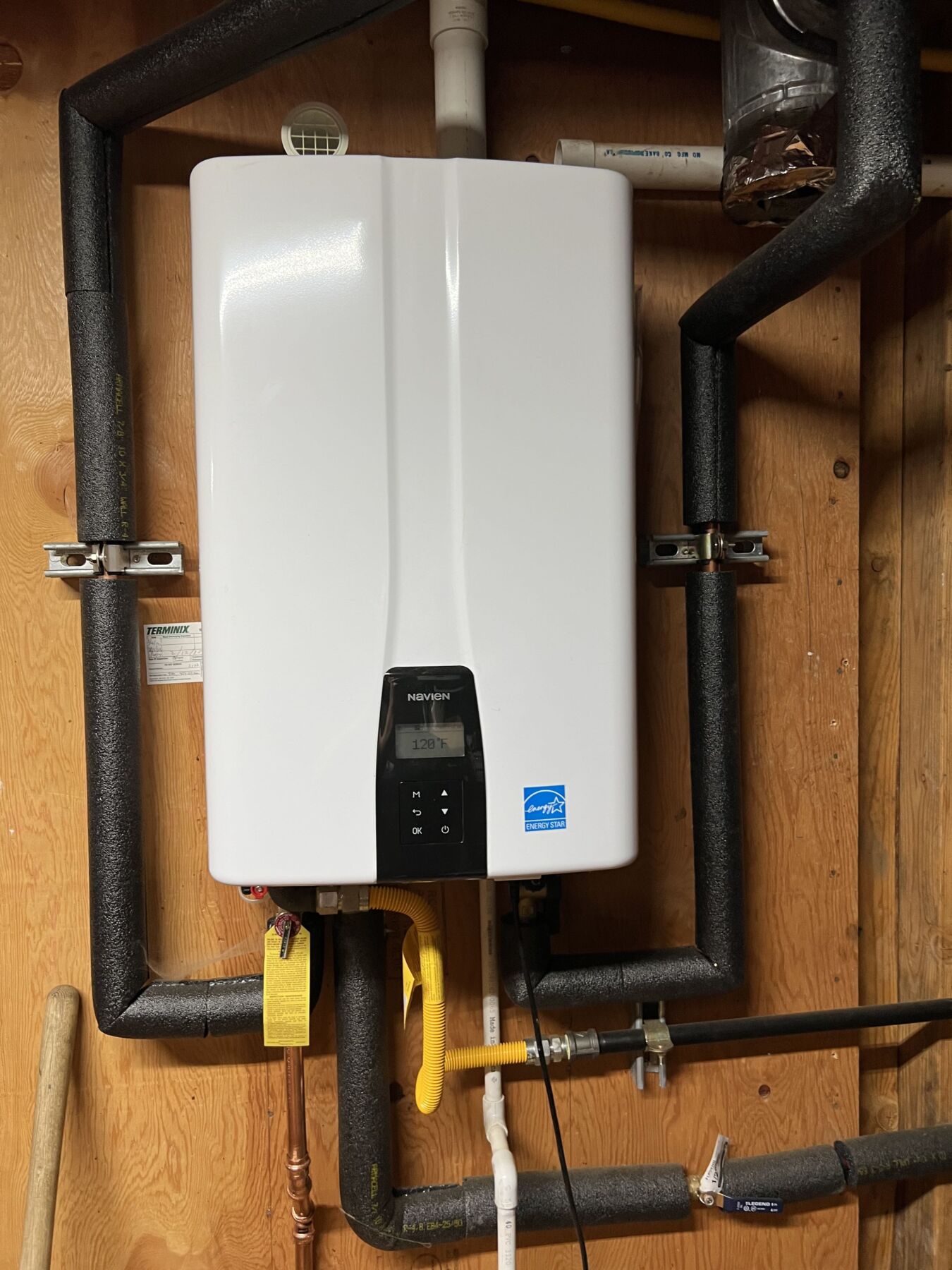
The Navien tankless system shown in this installation was installed in Twain Harte, California.
As with any tankless project, proper installation involves more than mounting the unit on the wall.
The gas supply, venting, water piping, condensate drainage and expected household demand all need to work together with the selected heater.
That planning is what allows a tankless system to deliver the performance homeowners expect after the conversion.
Tankless Water Heater Sizing & Installation
Optimized Plumbing & Piping installs and services tankless water heaters throughout the Sonora area and surrounding communities.
When evaluating a tankless conversion, we consider the home’s actual hot-water demand, incoming water temperature, gas supply and existing installation rather than simply choosing a unit from an advertised GPM number.
Proper sizing is what turns the promise of continuous hot water into a system that actually performs well in the home.
Optimized Plumbing & Piping
Tankless water heater sizing, installation and service.